Showing posts with label Quilt Museums. Show all posts

Thursday, February 14, 2013

Valentine's Day Eye Candy

As promised, today is show-and-tell of a portion of the crazy quilts I saw during my visit to the local historical society museum last Saturday.  To see my earlier post showing the pieced and appliqued quilts, click here.

This little museum had many crazy quilts on display and I only photographed a few.  The first one, shown in the next several photographs, was my favorite, for the many gorgeous fabrics, stitchery, and overall quality of workwomanship.  Without further ado:
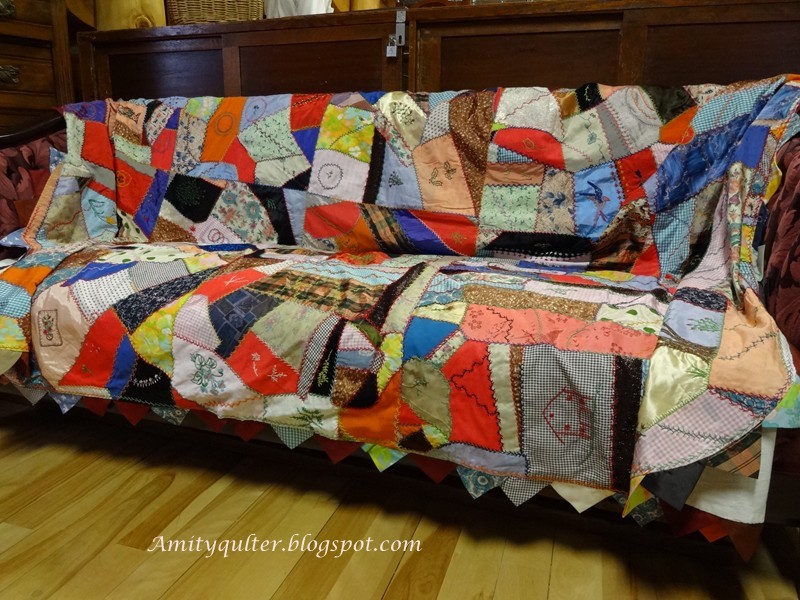
 Note the prairie point edging!


Closeup of what appears to be a child's block.  So sweet.  Also, note the tree trunk embroidery that straddles the edges of two pieces. 
 

 Lots of exquisite embroidery and fabrics.

 I loved the fabric featured in the above photo!  It appears in several other places in the quilt, in smaller patches.

The second quilt appears to be a friendship quilt, and is made up of everyday fabrics, more rustic in appearance than the first quilt shown above, but also containing some beautifully embroidered patches.  The side of the quilt facing me had dates of 1902,1904 and 1909 on the visible patches.
 I wondered about the doily placed rather haphazardly atop the quilt, but the reason became more apparent in the photo below.  Closer examination of the quilt indicated that although the blocks themselves were seamed together before embroidery, at least some of the pieces within the blocks appear to have only been held together with the fancy stitches, undoubtedly contributing to the overall fragile condition.

 
 A utility quilt.  Note the large binding on either side.

 Another utility quilt.
A friendship quilt, bound with heavy buttonhole stitches.

On the homefront, this has been a week of utility stitching after Monday's fun get-together with Barbara from Cat Patches and the monthly guild meeting.  Last year I picked up a small table-top quilters ironing board at a yard sale, that still had its original not-so-shiny gray cover and the thinnest possible layer of foam underneath.  Yesterday, it was finally time to make a new cover for the board.  I had some vintage home dec fabric that I'd been wondering how I would ever use (more inherited stash!).  I made a paper pattern of the old gray cover, traced it on the new fabric, and zig-zagged some 8-4 linen rug warp left over from my weaving days around the edges for a drawstring.  Two layers of nice cotton batting, cover on top, and I now have this:
There is plenty of fabric leftover to make a second cover when this one becomes scorched, which it surely will with time.  I saved the pattern with notations to cut it about an inch larger all the way around, since this one is just a tad smaller than I would have liked, due to the extra layers of padding that I hadn't accounted for.  Small oops, could have been worse.
I won't bother to show DH's old long sleeve shirts now neatly hemmed into short-sleeve summer gardening shirts, etc. etc.   More utility stitching (I refuse to call it mending) on today's docket, along with a long-overdue cleaning of the sewing room. 
Oh yes, Happy Valentine's Day!  We've decided to celebrate with an early morning trip to the coast and our favorite breakfast spot in Lincoln City the next time DH has a day off that coincides with sunshine!  Hopefully soon, but this is western Oregon ...


Saturday, February 9, 2013

A Visit to our Local Historical Society Museum

Today I had the opportunity to visit our local county historical society's museum which houses a nice variety of rural Oregon antiques, including some spectacular quilts, along with a genealogical library and some wonderful friendly volunteers who answer questions and provide guided tours of the buildings.    Today's visit was a direct result of an article by our local newspaper's historian in yesterday's edition regarding a community of Amish people who once lived in the valley approximately 2 miles as the crow flies from our home.  I hoped the museum might have some examples of true Amish quilts, and one of the volunteers brought out their one example, which wasn't currently on exhibit.  With white gloves on, she removed a very fragile and beautiful quilt from its box, and allowed me to photograph it.
The quilt, which was not dated, is in extremely fragile condition, although the blues have remained especially bright and striking.
A detail of the hand quilting motif.
Hand quilting as viewed from the back, which was originally green.

The museum has a wide variety of crazy quilts, which I'll show in a future post.  This post focuses on several other hand pieced and appliqued examples currently on exhibit.


This undated quilt has great movement in its pieced blocks and was one of my favorites.  The red fabric has faded badly and is worn through in a majority of the sashing. 

The striking snowball quilt top shown at the left in the photo above dates from the 1880s, and is thought to have been made from fabric pieces from a dressmaker's shop.  The circle pieces are backed with a muslin type fabric.  The quilt was never completed and large basting stitches are still visible.
Detail of the snowball quilt top.
The strips in this spider-web quilt dating to about 1928 are approximately 1/4 inch wide. 

This red cross friendship quilt dates to 1918.

Undated ribbon pinwheel quilt top.

Log cabin quilt, undated, constructed of primarily of velvets with some other fabrics.

I was unable to see the complete quilt, which is dated to approximately 1840.  Known as the Perkins Quilt, it  appears in the book Treasures in the Trunk by Mary Bywater Cross.

A great number of the quilts on  display were hand quilted with the Baptist Fan motif.  In some instances the fans were huge, as in the example on the left in the above photo.  I was particularly drawn to this particular quilt for the wonderful shadowing effect of the echoed quilting of the fans.  The embroidered and appliqued friendship quilt on the right dates to 1933.

This wonderful appliqued quilt dates to the 1870s, and is also featured in the book Quilts of the Oregon Trail by Mary Bywater Cross.  Each applique block measures at least 30 inches across.  Note the fading of some of the green leaves.

This sweet little quilt may have started life as a baby or doll quilt.  It was serving as a table topper in the exhibit.  I loved the fabrics in this, especially the yellows.

A beautifully quilted and well preserved example.  The quilt was undated.

Equally interesting is the chair it was draped across.   A birthing chair, the tag indicates it is over 100 years old, although I do not know if the 100 years is from the date in the 1970s when it was donated to the museum or 100 years from present time.  Happy that times have changed!

While I haven't sewn a single stitch today, it was a very happy quilting day!  I hope your day was equally rewarding with quilting pleasures.